
Abi Spring
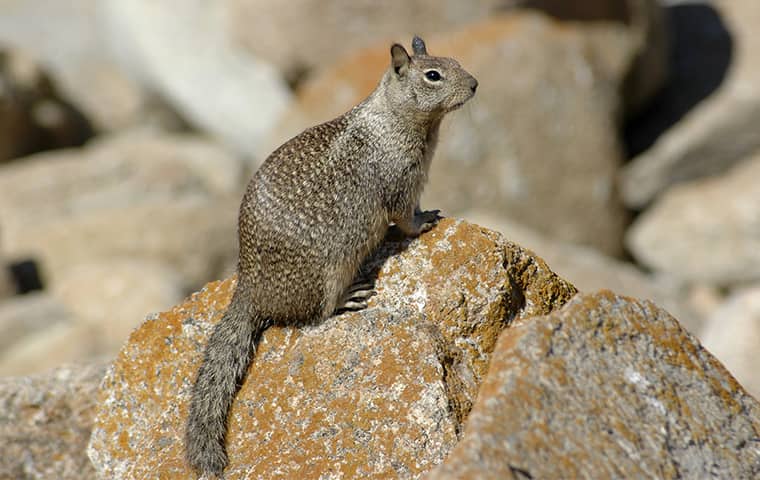
In these politically divisive times it can be hard to know what to talk about at a community get-together. Even in High Prairie attendees can range from hunters to vegans or even vegan hunters. (You know who you are!) But I assure you a safe topic, something everyone can agree on, is our universal dislike, or dare I even say, hatred of Californians… er um…I mean California Ground Squirrels, aka the evil Gray Diggers.
These garden pests, and their cousins the Voles, make gardening in High Prairie a challenge, and at a recent social event on Oda Knight Road the many varied attendees discussed how to deal with these destructive varmints.
California Ground Squirrels/Gray Diggers (in case you somehow have missed seeing them everywhere on your property) are, as the name implies, ground-dwelling squirrels. They are chunkier and a little larger than a tree squirrel like Washington’s Western Gray Squirrel. Ground squirrels are brown and gray and have a speckled appearance. They have a shorter, less flexible tail than the Western Gray Squirrel. The Western Gray Squirrel is… well… gray, as you might expect… and is a protected species, so unless you want bad karma for the rest of your lives, don’t kill them.
Voles are sneaky and devilish little monsters, who don’t seem to be afraid of anything. They are ground dwellers who make the holes in your yards and fields that look like piles of dirt, because they are piles of dirt. I love the aeration that they provide in our compact soil but I do not love that they eat the roots of all my plants. And they are audacious! I was sitting in my garden admiring a lovely purple cosmos flower I had grown from seed, when I noticed that it seemed to be waving in the breeze a lot more than I would expect on one of the rare calm days at my house. As I went to investigate, the entire plant started to disappear into the ground. I grabbed my plant, thinking surely I could prevent its disappearance, and I did; but when I pulled it up there was a small brown animal attached to it. Shocked, I dropped the flower, but did the little beast let go and retreat like you would expect any animal pulled from its home would? No. It was trying to pull the entire cosmos plant back into the ground with it. I felt like I was in an old Bugs Bunny cartoon: it was a tug-of-war between me and a little brown creature. Eventually I won, but it was then that I decided some extreme measures needed to be taken.
But even as murderously enraged as this event made me, I have not resorted to lethal control, i.e. trapping and poisoning, etc. It is too hard to target just one species, and no one wants a visit from the game warden after a neighbor reports you for killing a fluffy innocent Western Gray Squirrel. Also, poisoning too frequently ends up killing not only the target species but the animals that naturally keep the target species in check. And there is also the potential liability that might result from having someone misinterpret my lethal advice: I watched a YouTube video of someone pouring gas into their varmint holes, igniting it and blowing up their entire yard. I am going to stick to recommending non-lethal tricks that make gardening slightly less difficult. No Wile E. Coyote advice here.
But first let me list a few of the things I have tried that haven’t worked:
Hot pepper – This is perhaps the most Coyote-like trick I employed. I dumped cupful after cupful of hot chili powder around my plants. Not only didn’t this seem to matter to the voles, it did seem to burn the leaves and my eyes.
Sound spikes – These are plastic solar powered sound and vibration emitting spikes that you push into the ground that supposedly deter animals. They didn’t seem to deter mammals, but did deter song birds and humans. The sound drove me crazy.
Small terriers – These do work on the ground squirrels but the voles are too well protected by their tunnels to be deterred by the terriers digging and yapping. Also their digging can destroy plants and their yapping can destroy minds.
Motion activated sprinklers – These also work on ground squirrels and not on voles. They also are just as easily triggered by me as they are by varmints. Getting sprayed when you aren’t expecting it just isn’t that pleasant. Note: Motion activated sprinklers work great on keeping birds and ground squirrels from eating the fruit on our trees; and since the trees are located away from the main traffic areas, they work well there, rather than in our yard. I recommend them enthusiastically for that application.
The things that do work are going to sound extreme and well, frankly, they are. I frequently revisit the question of whether or not gardening in the High Prairie is worth the effort. Perhaps I should just spend my money supporting the farmer’s market, or getting more food through the monthly co-op delivery at the community center? Save my energy for splitting wood and expanding our fire protection perimeter? Save my water for more essential things like drinking and bathing? Maybe I will eventually give up, but until I do these are the techniques that I use to protect my flower and vegetable gardens:
Barriers – Barriers are the primary method I use to prevent destruction. In the flower garden where individual plants are distributed around and group plantings don’t really work, I employ stainless steel wire baskets also called gopher baskets or bulb baskets. These are available online from any number of distributors. Individual plants or small groups of bulbs are planted in these soft wire mesh baskets. If the plants are of particular interest to voles (oriental poppies seems to be a favorite) I thread a wire around the top and draw the basket closed around the stem, as voles have been known to dig underground to the edge of the planted basket, emerge from the ground, cross the barrier and burrow back in and eat the roots. Did I mention I really dislike voles?
In the vegetable garden, or in areas of mass plantings like an iris bed, I use raised beds made from dimensional lumber. Cedar is best, if you are made of money, because of its natural resistance to rot. If not, pine is good. I don’t use pressure-treated wood because I am old enough to remember when pressure treated wood contained arsenic and arsenic is bad for people. They say that pressure-treated is safe now, but my pine beds last long enough for me, without having to think too much about who is testing what, when.
The absolute minimum for raised beds I think is 12 inches; deeper is better. On the bottom of the bed I staple hardware cloth, wire mesh with a 1/4 to 1/2 inch grid. I also create a cover from hardware cloth using a combination of bamboo, origami, and PVC pipe. You do you. The important part is that the covers allow you to water the plants without removing them and are easy enough to remove to harvest the vegetables.
I use scrap dimensional lumber to weigh down the edges of the covers and prevent rabbits and ground squirrels from entering. Also, the covers are great supports for shade cloth which extends the growing season for heat sensitive plants like spinach and other greens. It looks like a prisons for plants. Or maybe castles is a nicer way to think about it? Or witness protection?
Spray – Another non-toxic technique I employ is to spray the gardens with a 50/50 mix of dish soap and castor oil (preferably not on the actually plants.) There is something about the smell of castor beans that varmints hate. The dish soap is only there to make it sprayable. I put the mixture in an old Miracle Grow sprayer that I attach to my hose. The sprayer is left over from… I can’t even remember when I would have purchased Miracle Grow, but any bulk sprayer will work. You can use a pump sprayer that you can pick up at a hardware store. (Just make sure you don’t use one that was previously used for something you wouldn’t want to eat.)
I haven’t even touched on perhaps the most destructive and prevalent species here: deer. We were lucky enough to have had both a small yard and larger vegetable garden area already fenced in with 6ft high fences when we purchased our place 7 years ago. Without the fences to keep deer away, any of my listed techniques would be moot except for maybe the gasoline explosion. That might deter deer, but how often would you need to do it?
To Abi Spring, Facebook Friend. Thank you Abi for your thoughtful and descriptive article on surviving the ongoing issue with California Ground Squirrels. I particularly liked your approach to non lethal ways to discourage CGSs from your property and garden… very useful information.
PS. According to my references, CHSs have been migrating north as the climate changes overtime. Hard to imagine a pregnant GHS “swimming” the Columbia River to make it to Washington as the first “invader”And that would be quite a feat. I think CGSs are cute with their overbite.