
Peter Rowe
All of these images were taken from High Prairie in view of the Community Center.

Crab Nebula
The Crab is a special nebula because it is the first recorded supernova (exploded star) observed by humans. In the year 1054 AD it was seen by Native American, Japanese, and Arabic stargazers. At the same time Chinese astronomers noticed a “guest star” that was visible in the daytime sky for nearly a month, this was recorded on July 4th 1054 AD. The Crab Nebula is also the first entry in the Messier Catalog where it is called M1 (of about 100 entries).

Heart Nebula
No guesses as to why this is called the Heart Nebula! The Heart nebula is huge, about 4 times the size of the moon, but it is dim so it needs to be captured for a long time. The Heart Nebula is made up of ionized oxygen and sulfur gasses, which are responsible for the blue and orange colors. The nebula’s lighting is driven by radiation emanating from a small group of bright stars near the nebula’s center, some of these are nearly 50 times the mass of our Sun.
,
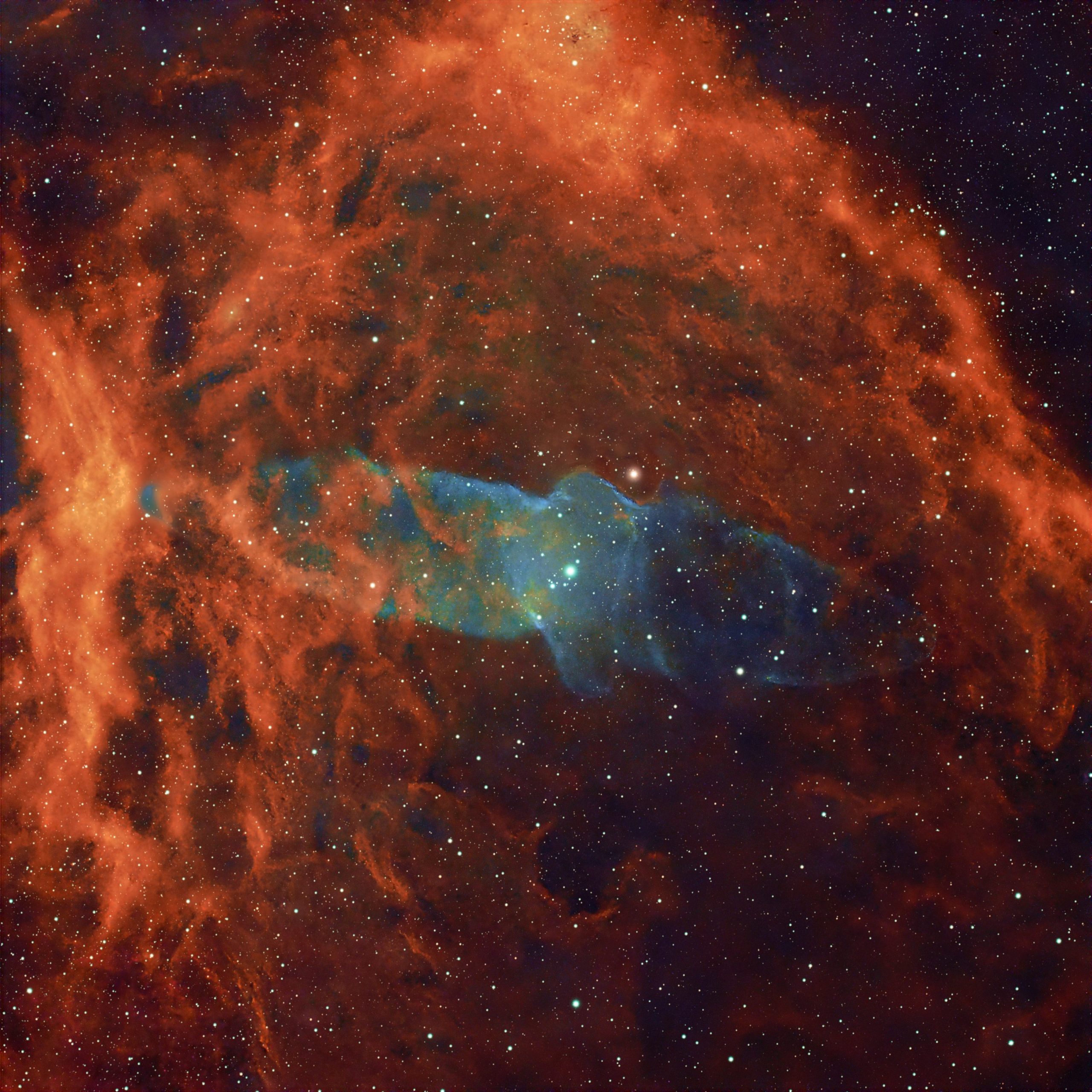
Squid Nebula
The Squid nebula is really two nebulae – the hydrogen-rich ‘Flying Bat’ nebula shown in red, and the much dimmer ‘Squid’ shown inside in oxygen blue. The Squid is so dim that it was only discovered in 2011, when a French astronomer accidentally left his telescope pointing at the Flying Bat over a long period. The Squid portion of this image took over 30 hours to capture over many different nights. The Squid itself is thought to be a star near the end of its life, blasting its outer layers off in two opposite directions.
Equipment
For anyone interested, the equipment I use to capture these images:
AM5 Mount; ZWO FF65 and EdgeHD Telescopes; ASI533MC Camera; Celestron OAG with ASI174MM guide camera